Nexus v3: A Better Memory for the Stories You Keep
 Namai
NamaiContents
Memory Nexus began with a simple promise: if a character makes a promise in chapter one, it should still matter in chapter twenty.
That sounds simple until a story grows. A character disappears for a hundred messages and comes back. A secret stops being secret. A ring changes hands. Someone who distrusted you becomes the person you trust most. The story keeps moving, and its memory has to move with it.
Nexus v3 is built to make that feel effortless.

Why Nexus was rebuilt
The first Nexus kept a growing recap and notes about characters. Nexus v2 organized the story more carefully, but it kept too much that was only important for a moment. Passing details became saved facts, important details could still slip away, and managing memory started to feel like another task for the player.
Memory should leave players thinking about what their character says next, rather than whether they need to clean up a memory panel.
Simply saving more could not fix the problem. A long-running story also needs to know when a fact has changed. If an injury heals, the old injury should not keep showing up as if it happened yesterday. Nexus v2 could revise facts, but it was too passive about doing so. Nexus v3 is designed to be more proactive, especially in Pro.
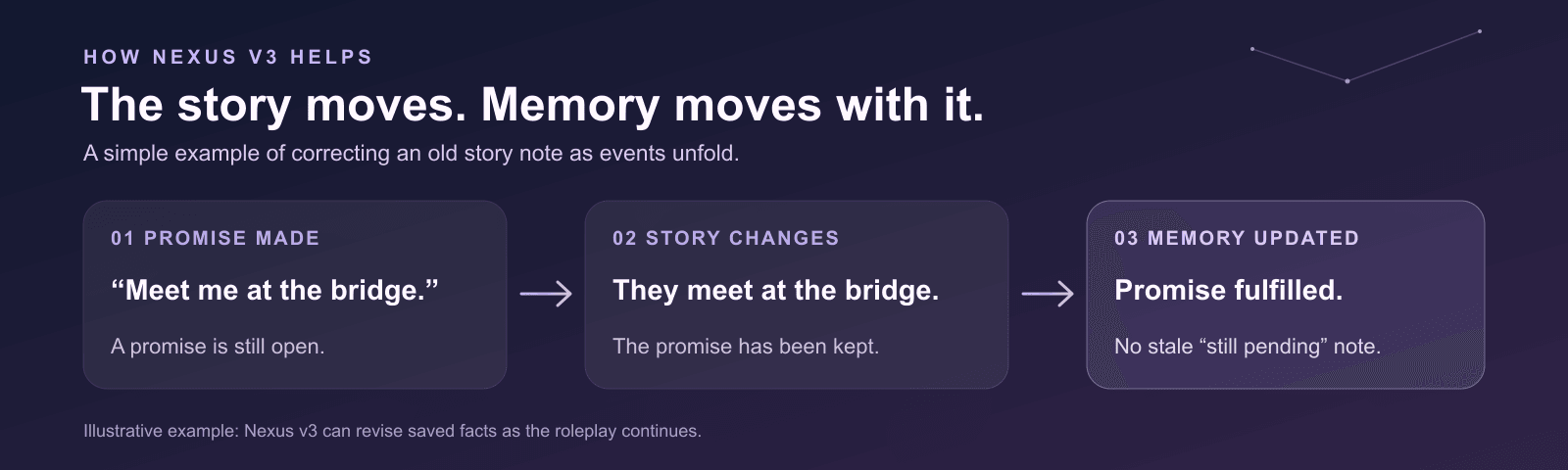
It's a small example of the intended experience: the story advances, and its memory follows. Fleeting moods and actions stay in the scene instead of becoming permanent lore.
A 400-message adventure put it to the test
The test used an isekai roleplay that begins with a child born into another world. Years later, that character reaches an academy and meets three betrothed princesses: human, elf, and dragon. The story has room for relationships, secrets, promises, rivals, and people returning after a long absence.
Four generations of Nexus processed 400 messages of that adventure. A set of 152 questions checked what each version remembered. The test also counted the entities and details each version saved, and how many of those details remained useful beyond the scene where they appeared.
| Version | Questions answered | Entities recorded | Details recorded | Lasting, story-relevant details |
|---|---|---|---|---|
| Nexus v1 | 96 / 152 | 22 | 105 memories | 41% |
| Nexus v2 | 114 / 152 | 31 | 115 facts | 52% |
| Nexus v3 Base | 131 / 152 | 38 | 294 facts | 73% |
| Nexus v3 Pro | 144 / 152 | 45 | 325 facts | 84% |

V3 Pro answered 48 more questions correctly than v1. The last column matters just as much: in this test, only 52% of v2's saved facts were lasting story details; for v3 Base it was 73%, and for Pro it was 84%. V3 saved more, but a much larger share of what it saved was worth carrying forward.
These numbers come from one story and do not guarantee the same result in every roleplay. V1 stored memories while the later versions stored facts, so the entry counts are not identical units. They show how much of this world each generation tried to track.
A different story, Glass Harbor, tested a 120-message romance and mystery. Recent conversation alone answered 51 of 80 story questions. With Nexus memory, that rose to 76 of 80. It is a separate benchmark, but it tests the same idea: when an old detail matters again, the story should still know it.
Less memory management, more roleplay
Nexus v3 is designed to reduce memory upkeep as the story unfolds while giving players more control when they want it. Open Nexus to see the people, places, and moments it remembers, review new memories, and correct a detail it got wrong.
For new chats, Nexus Base is the default. Existing Nexus chats stay on Pro unless you switch. You can change modes inside your chat, so you can choose the level of memory that fits that story.
A regrettable price change
Running and managing this version of Nexus has become much more expensive. As a result, Nexus Base is increasing from 0.5 to 1 credit per new reply. Nexus Pro costs 2.5 credits per new reply. Regenerating a reply adds no Nexus charge. This increase is regrettable, and it deserves a clear explanation rather than a quiet change to the price list.
Base is still included at no extra charge with Max, so Max members can keep writing without an added Base charge.

Nexus credits are added to the selected chat model's price unless your plan includes that model or mode.
Stories this big deserve a memory that can grow with them. The first Nexus helped them remember. Nexus v3 is built to help them carry a history.